
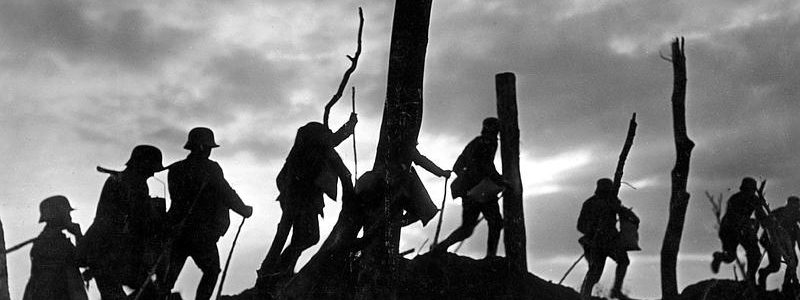
The novel A Farewell to Arms (1929) holds a special place in the work of Ernest Hemingway. Based on the author’s own experience serving on the Italian front during World War I, the text combines stylistic restraint with deep psychological intensity. Yet it is not merely a war novel in the traditional sense. It is a work about inner disintegration, about the attempt to preserve love in a world dominated by destruction and death.
Hemingway constructs a literary model of war that is far removed from heroic epic. At the center of the narrative are not military strategies or battlefield triumphs, but the personal experience of an individual forced to exist within historical catastrophe. Frederick Henry is a protagonist whose consciousness gradually frees itself from illusion. His journey is one from passive participation to conscious refusal, from external obedience to internal rupture.
The love story is not a decorative subplot. It becomes the novel’s semantic counterweight to war, a space in which the characters attempt to find private happiness and personal freedom. Through the contrast between war and love, the tragic scale of the novel is revealed.
War as the Destruction of Illusion and Human Integrity
In traditional war narratives, conflict is often framed as a test of courage and loyalty to duty. In A Farewell to Arms, however, war is stripped of romantic aura. It is portrayed as a realm of chaos, randomness, and absurdity.
Battle scenes are not transformed into moments of heroism. Hemingway depicts mud, exhaustion, fear, meaningless orders, and disorganized retreat. The episode of the Italian retreat is especially significant: the army collapses into confusion, and soldiers begin accusing one another of betrayal. Executions carried out in panic reveal that war destroys not only bodies but also the moral foundations of society.
Frederick Henry enters the war without ideological fervor. He is not driven by patriotic slogans or a desire for glory. His involvement seems almost accidental. Yet this ordinariness makes him representative of a modern individual caught within a historical mechanism he does not fully understand.
Henry’s injury becomes a turning point. It symbolizes not only physical trauma but also a crack in his perception of war. After his hospitalization, he returns to the front already internally distanced. His alienation intensifies when he encounters arbitrary accusations and the irrational violence of his own army.
In the novel, war is not only a battlefield but also a psychological condition. It corrodes personality and strips away stable points of reference. Hemingway suggests that under total violence, traditional values—“honor,” “duty,” “glory”—lose their substance. Words remain, but meaning dissolves behind them.
Love as Private Refuge and Fragile Hope
Against the devastation of war unfolds the love story of Frederick Henry and Catherine Barkley. Their meeting initially appears casual, almost accidental. Gradually, however, their relationship becomes the emotional core of the novel.
Catherine is a woman already marked by loss. Her fiancé was killed in the war, and she lives in a state of suppressed grief. In this, she mirrors Frederick: both attempt to shield themselves from fear and emptiness. Their love begins almost as a game—a distraction from reality—but slowly deepens into genuine attachment.
Love in the novel is not idealized. It is not depicted as absolute salvation. Rather, it develops under constant threat. Precisely because of this threat, it gains intensity. The lovers attempt to construct a private world—one without war, commands, or death.
Their escape to Switzerland symbolizes a crossing not only of geographic borders but of existential ones. They try to leave behind the machinery of destruction and create a space of peace. Yet even there, their happiness feels fragile. War remains present as a shadow, an inescapable context.
For Hemingway, love is a form of resistance. It affirms life in a world governed by death. Yet this resistance is limited. The tragic ending underscores that private feeling cannot entirely negate historical brutality.
The Antihero Against the Military Myth
Frederick Henry stands as one of the most striking antiheroes of twentieth-century literature. He does not seek heroic feats, nor does he speak in patriotic rhetoric. His choices are guided by a desire to preserve his life and his love.
This portrayal sharply contrasts with traditional military narratives in which the soldier embodies national pride and moral steadfastness. Hemingway dismantles this myth. His protagonist is doubtful, weary, and disillusioned.
Henry’s refusal to continue participating in the war is not cowardice but an act of inner honesty. He rejects a system devoid of meaning and justice. In this gesture, a new model of courage emerges—the courage to recognize absurdity.
Antiheroism becomes a literary device through which Hemingway critically reexamines the very idea of war as a “glorious” event. The reality of the front is incompatible with romantic imagination.
Stylistically, Hemingway’s restrained “iceberg” method intensifies authenticity. Emotions are rarely articulated directly; they are implied through understatement and silence. This economy of expression creates a tense, truthful atmosphere that amplifies the novel’s tragic resonance.
Tragedy as the Inevitable Outcome
The novel’s conclusion shatters its final hope. Catherine’s death in childbirth becomes the culmination of tragedy. Their child does not survive. The fragile happiness they painstakingly built vanishes in an instant.
This tragedy carries no moral lesson. It is not punishment for desertion or defiance of duty. Rather, it appears as an expression of the world’s randomness and cruelty. Here lies the philosophical depth of the novel.
Hemingway suggests that the world offers no guarantee of justice. One may strive for love, honesty, and sincerity—yet still face loss. Suffering is not an exception but a condition of existence.
Frederick is left alone. His solitude marks not only personal grief but the final consequence of his wartime experience. He bids farewell not only to arms, but to illusions. In this ending lies the novel’s stark truth: war destroys not only lives, but also faith in the stability of the world.
What Is Especially Important to Understand
- War is depicted not as a heroic stage, but as a chaotic and destructive force devoid of romantic meaning.
- Love functions as a personal form of resistance to historical violence.
- Frederick Henry dismantles the traditional myth of the heroic soldier.
- Hemingway’s restrained style deepens the emotional impact and underscores the emptiness behind military rhetoric.
- Loss is presented as inevitable within a world shaped by catastrophe.
- The novel demonstrates the fragility of private happiness amid systemic destruction.
Conclusion
A Farewell to Arms is a novel in which the theme of war is refracted through intimate personal experience. Hemingway creates a new type of war narrative—one stripped of pathos yet saturated with existential depth.
Through the contrast between war and love, through the figure of the antihero and the devastating finale, the author reveals that the greatest loss in times of catastrophe is the loss of illusion. War dismantles familiar values, yet in that dismantling human vulnerability becomes visible.
The novel remains relevant because it poses universal questions: Can personal integrity survive in a world of violence? Can love serve as refuge when historical order collapses? Hemingway’s answer is not consoling, but it is honest. And in that honesty lies the enduring power of his art.