
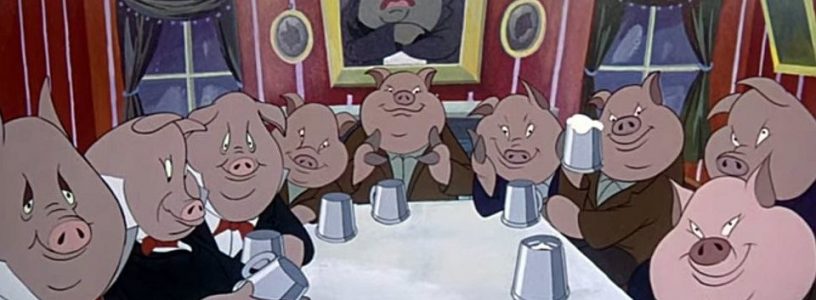
The novella Animal Farm (1945) is one of the most concise yet powerful works of the twentieth century. In it, George Orwell employs allegory to reveal the mechanisms of power, ideology, and political manipulation. At first glance, the story appears simple: animals overthrow a farmer and attempt to build a just society. Yet beneath this apparent simplicity lies a profound analysis of political processes, revolutionary rhetoric, and the transformation of ideals.
In this work, allegory is not merely a literary device. It becomes a tool of political understanding. Through the behavior of the animals and the gradual alteration of their guiding principles, the author exposes universal patterns in the formation and degradation of power. Thanks to its allegorical form, the text remains relevant far beyond its historical context.
Allegory as a Literary Mechanism and a Form of Political Thinking
Allegory operates on two levels: the literal and the symbolic. In Animal Farm, the literal level concerns life on the farm, the animals’ revolution, and their attempt to create an egalitarian community. The symbolic level reflects twentieth-century political history, particularly revolutionary movements and the rise of totalitarian regimes.
Each character fulfills a symbolic function. The pigs represent an intellectual elite that gradually usurps authority. Boxer the horse embodies the working class—loyal, hardworking, and devoted to the cause, yet lacking critical awareness. The sheep symbolize the masses, easily influenced and inclined to repeat simplified slogans.
Through allegory, Orwell avoids direct political pamphleteering. Instead of explicit accusation, he presents a universal model of political dynamics. Readers are invited to interpret the parallels themselves, which strengthens the impact of the narrative. Conclusions emerge through reflection rather than prescription.
Language plays a crucial role in this process. The maxim “All animals are equal” eventually becomes “All animals are equal, but some animals are more equal than others.” This transformation illustrates how language can legitimize inequality. The words remain, but their meaning shifts.
In this way, the novella demonstrates that political power is sustained not only through force but also through control over interpretation. Allegory makes this process visible, allowing readers to observe how ideals gradually evolve into instruments of domination.
The Formation of Power: From Revolutionary Ideal to Hierarchy
The revolution on the farm begins with a promise of liberation. Old Major outlines a utopian vision of a society free from exploitation. At this stage, the allegory reflects the enthusiasm typical of revolutionary movements—faith in equality, solidarity, and collective justice.
After victory, however, a different dynamic emerges. The pigs begin consolidating authority, justifying their privileged status as necessary for organization and leadership. They claim special rights under the pretext of protecting the common good.
The allegory traces how a new hierarchy forms. Power is strengthened through monopoly over education and information, the rewriting of rules, the creation of external enemies, and the cultivation of fear. Each element mirrors real political mechanisms, though presented in symbolic form. Gradually, equality gives way to authoritarian structure, where stability is used to justify control.
Napoleon’s rise is particularly significant. His transformation from revolutionary ally to dictator reveals how leadership, initially framed as service, can become absolute authority. He rarely acts openly; instead, he relies on propaganda, intimidation, and repression carried out by intermediaries.
The allegory suggests a broader pattern: without institutional safeguards and critical accountability, revolutions risk reproducing the very systems they sought to dismantle.
Manipulation of Language and Collective Consciousness
One of the novella’s central themes is linguistic control. Squealer, the pigs’ spokesman, constantly reinterprets events and justifies changes to the farm’s principles. Through rhetorical manipulation, selective reasoning, and appeals to fear, he reshapes the animals’ perception of reality.
The repeated alteration of the farm’s commandments symbolizes the rewriting of history. The animals sense inconsistencies but doubt their own memory. This illustrates how collective consciousness depends on shared narratives and how easily those narratives can be reshaped.
Repetition becomes another powerful tool. The sheep drown out debate with simplistic slogans, reducing complex political realities to chant-like formulas. Public discourse becomes narrowed and emotionally charged rather than rational and reflective.
The following table outlines key allegorical elements and their political meanings:
| Allegorical Element | Literal Level | Political Meaning |
|---|---|---|
| The pigs | Farm leaders | Ruling elite controlling authority |
| Boxer | Loyal work horse | Working class devoted to ideology |
| The sheep | Slogan-chanting animals | Mass consciousness shaped by propaganda |
| Rewriting the commandments | Changing farm rules | Manipulation of history and truth |
| Napoleon | Leader of the pigs | Authoritarian ruler |
Through such symbolism, Orwell makes abstract political processes concrete. Minor adjustments accumulate into profound systemic change. What appears gradual and insignificant ultimately transforms the entire structure of society.
The Universality and Continuing Relevance of Allegory
Although Animal Farm was written in a specific historical context, its meaning transcends any single era. The allegory reveals recurring patterns: concentration of power, manipulation of fear, and symbolic justification of inequality.
In the novel’s final scene, the animals observe the pigs and humans and can no longer distinguish between them. This image underscores the cyclical nature of political systems. Power, when unchecked, tends to replicate the structures it once opposed.
Allegory thus serves a dual function. It critiques particular historical developments while simultaneously cultivating critical awareness in readers. By abstracting political mechanisms into symbolic form, the text invites reflection on authority, responsibility, and civic vigilance.
Animal Farm ultimately becomes more than a literary work; it becomes an educational framework for understanding political transformation. It reminds readers that the defense of equality requires not only inspiration but also institutional transparency, active participation, and sustained critical thought.
Key Takeaways
-
Allegory in Animal Farm provides a universal model of political power.
-
The novella demonstrates how revolutionary ideals can evolve into authoritarian structures.
-
Control over language and historical narrative is a central mechanism of domination.
-
Allegorical storytelling strengthens critical thinking and ensures the text’s enduring relevance.
Conclusion
Animal Farm illustrates how literature can illuminate the nature of power through allegory. The story of the farm becomes a universal model of political transformation, where ideals gradually yield to control and inequality.
The novella reminds us that without critical thinking and accountability, power is prone to reproducing the very forms of oppression it once resisted. For this reason, Orwell’s allegory remains strikingly relevant today.